
Gold is one of the most valuable metals. We use gold in jewellery, in phones and gadgets and to save money. Many people think about where gold comes from. You cannot just find it anywhere. Gold has a long journey before it becomes a coin, a bar, or a piece of jewellery.
In this article, you will learn how gold formed in space, how it came to Earth, where it is found today, how people mine and refine it, and why it is so rare and precious. By the end you will know the full story of gold, from the stars to the bars and coins you can hold.
What Is Gold?
Gold is a chemical element. Its symbol is Au on the periodic table. Gold is a precious metal that has a bright yellow colour. It is soft but lasts a long time. Gold does not rust or get damaged easily. This is why people have valued it for thousands of years.
Gold has special properties that make it useful for many things. People use it in jewellery, electronics, and coins. Its shine, durability, and rarity make it different from other metals. When people ask “what is gold,” they mean this metal that is both beautiful and valuable.
Real Origin of Gold
Gold did not form on Earth. It was created billions of years ago far out in space. Scientists say gold came from extreme cosmic events that happened long before our planet existed.
One way gold formed was when massive stars exploded. These explosions, called supernovae, sent dust and tiny particles into space. Another way was when neutron stars collided. Both events created heavy elements like gold through nuclear reactions.
All this cosmic dust, full of gold and other elements, spread through the universe. Over time, some of it came together to form planets, including Earth. This is why the gold we have today started its journey in space, not here on our planet.
How Gold Reached Earth
When Earth formed about 4.6 billion years ago, tiny gold particles were already floating in space. These particles joined together as the planet took shape. Most of the gold sank deep into the Earth’s core because it is heavy.
Some gold stayed closer to the surface. Meteorites carrying gold crashed into Earth, adding more of it. Volcanic activity and movements of tectonic plates also pushed gold from deep underground toward the crust.
Today, the gold we can mine is mostly found in the Earth’s crust. It took billions of years of natural processes like meteorite impacts, volcanic eruptions, and shifting plates to make it reach the places we can access now.
Where Gold Exists on Earth
Gold exists in many places on Earth, but usually in very small amounts. You cannot see most of it with the naked eye, and it spreads out in tiny particles.
Gold is commonly found in these places:
- Rocks, where gold is trapped inside minerals
- Soil, mixed in small amounts with dirt
- Rivers, where water carries tiny gold particles
- Oceans, where dissolved gold floats in the water
- Even the human body, with very tiny traces of gold
Gold is almost everywhere, but it is so rare that we cannot collect it easily. Even in the oceans, a huge total amount exists, but we cannot use it because it is too diluted.
Main Types of Gold Deposits
Gold does not appear randomly. It usually forms in certain types of deposits in the Earth. These deposits are places where gold collects over time and becomes easier to find. Knowing the types helps miners and investors understand where gold comes from.
Here are the main types of gold deposits:
| Type | Description |
|---|---|
| Quartz vein deposits | Gold trapped inside quartz rock |
| Placer deposits | Gold washed into river sand and gravel |
| Alluvial deposits | Gold carried by water over time |
| Underground deposits | Gold deep inside rock layers |
Countries That Produce the Most Gold
Gold is mined in many countries, but some produce much more than others. These countries have large reserves or big mining industries. Knowing where most gold comes from helps understand global supply.
Here are the main gold producing countries:
| Country | Gold Production |
|---|---|
| China | Largest gold producer |
| Australia | Large open pit mines |
| Russia | Major mining industry |
| Canada | Large reserves |
| South Africa | Historically biggest gold producer |
South Africa used to produce about 40% of all the gold ever mined. Today, it remains important, but countries like China and Australia now lead in global gold production.
How Gold Is Mined Today
Before any gold is mined, geologists first look for it. They study rocks, soil, and land formations to see where gold might be. They drill small holes and take samples to check if gold is really there. This exploration helps mining companies know exactly where to start digging.
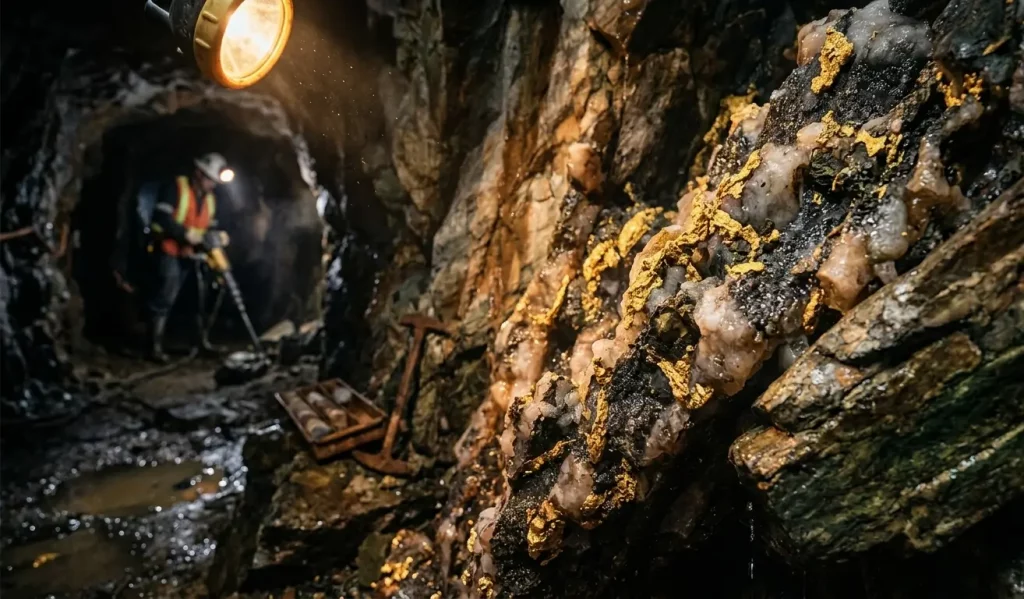
Miners use three main methods to mine gold today. They use open pit mining when gold lies close to the surface. Miners dig out large areas of land and use machines to remove rocks to reach the gold. They use underground mining to extract gold from deep inside the Earth. Miners dig tunnels and shafts to reach the gold, sometimes hundreds of meters below the ground. Placer mining collects gold from riverbeds, sand, or gravel. Water helps wash the gold out from the surrounding material.
You almost never find gold in big chunks inside rock. It usually spreads in very tiny pieces. This means miners must dig and process large amounts of rock to get even a small amount of gold. Machines crush the rocks and separate the gold from dirt, sand, and other minerals.
Mining equipment today is very advanced. Big trucks, drills, crushers, and conveyor systems help move rocks and extract gold safely. Modern methods also try to reduce waste and protect the environment while still getting the gold. Even with these machines, mining takes time and effort, which is why gold is still rare and valuable.
From Gold Ore to Gold Bars
Turning gold from rock into bars or coins takes several steps. Miners first mine gold ore from the ground. Then they crush the rock into small pieces to release the gold inside.
Next, chemical processes extract the gold from the crushed rock. This step removes most of the other minerals and dirt. After that, the gold is refined and purified. Modern methods make it about 99.99% pure.
Finally, refiners cast pure gold into bars, coins, or other shapes. People call these forms bullion. This refined gold is what people buy, sell, or invest in.
Why Gold Is So Rare
Gold is rare because it only forms in very special events in space. Exploding stars and colliding neutron stars create gold. These events do not happen often, so gold is always limited.
On Earth, only tiny amounts of gold exist in the crust. Most of it sank deep into the core when the planet formed. Mining gold is hard and expensive because it takes a lot of work to reach the small amounts near the surface.
New gold deposits are getting harder to find. All this makes gold scarce and keeps its value high. People trust gold because there is only a limited supply in the world.
Why Gold Is Important for Investors
Gold has kept its value for hundreds of years. People have used it to preserve wealth when money or economies change. This is why investors still look at gold today.
Many investors buy gold to protect their savings. It can act as a hedge against inflation, which means it holds value even when prices rise. Physical gold, like bars and coins, is very popular with UK investors because they can see and hold it.
Gold bullion and gold coins are often seen as a safe long-term investment. People buy them to protect their wealth and plan for the future. For anyone in the UK thinking about gold investment, having physical gold is a trusted choice.
Conclusion
Gold started its journey in space billions of years ago. It traveled to Earth as the planet formed and became part of rocks, rivers, and oceans. Over time, geological processes concentrated gold into deposits that miners could reach. Today, it is mined, refined, and made into bars, coins, and other forms.
Gold is rare, and that is why it keeps its value. Understanding where gold comes from and its origin helps investors see why it is trusted. For anyone thinking about protecting savings or making a long-term investment, physical gold like bullion and coins is a smart choice.
FAQs
Where does gold originally come from?
Gold comes from space. It formed billions of years ago during massive star explosions and neutron star collisions.
How did gold reach Earth?
Gold arrived on Earth when the planet formed and through meteorites that carried gold from space.
Where is gold found on Earth?
Gold is found in rocks, rivers, soil, and deep underground. Most of it exists in very small amounts.
What are gold deposits?
Gold deposits are places where gold collects over time, like in quartz rocks, riverbeds, or underground layers.
How is gold mined?
Gold is mined using open pit mining, underground mining, or by collecting it from riverbeds using water.
Why is gold so rare?
Gold is rare because it forms only in special space events and only small amounts exist in the Earth’s crust.
How is gold turned into bars or coins?
Miners extract gold from rock, refine it to remove impurities, and then shape it into bars or coins.Why is gold valuable for investors?
Gold holds its value over time and helps protect money during inflation or economic uncertainty.